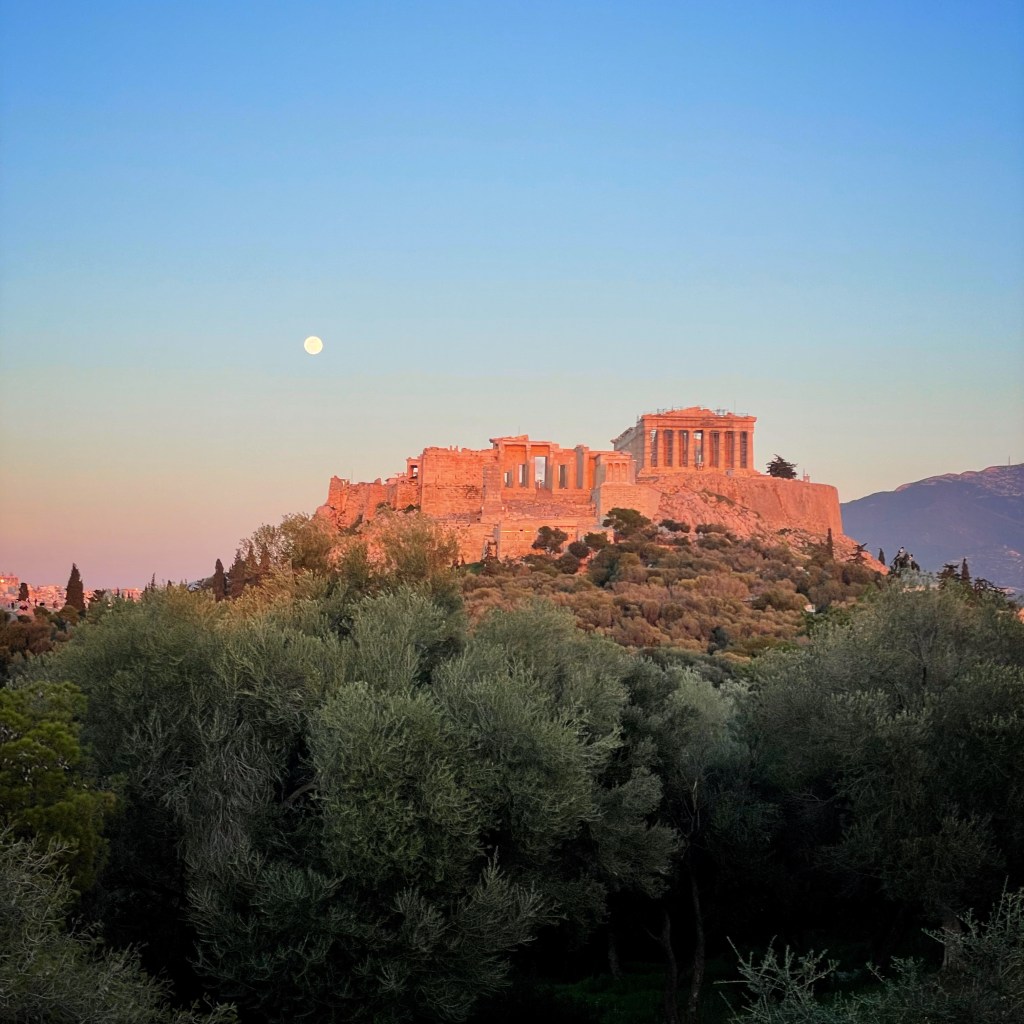
A full moon rising above the acropolis.
In this first part of my Athenian adventure, we’ll wander through the city’s breathtaking historical sites. For those with an appetite for more, Part 2 will be my culinary odyssey, savoring the rich flavors and irresistible dishes that define Athens’ vibrant food scene.
First Stop: Filopappou Hill
I decided to treat myself to a short trip to Athens’ after my Greek History oral exams in February. It was the destination at the top of my bucket list, and I had $300 travel credit, so I thought, “why not?” I arrived on a Friday afternoon, and after a swift hotel check-in, I found myself ascending Filopappou Hill to begin my sightseeing.
I saw the modest remains of the Prison of Socrates, a series of ancient chambers more steeped in legend than historical fact, but a reminder that it was always a dangerous idea to teach young people to think for themselves. Socrates was accused of negatively influencing the young people of Athens; his teaching style encouraged questioning and dialectical exchange. Like TikTok in America today, he was seen as a threat to the traditional values and beliefs of Athenian society due to the fact that he drew unwanted attention from the powers that be.
After taking in one of the most beautiful sunsets in my life, watching the pinks turn to purples at the full moon rose over the the Acropolis, I explored a little more with the last few photos of daylight. The Pnyx stands as a rugged beacon of democracy, a simple hill where, from the early 5th century BC, ordinary Athenians congregated in the open air to passionately carve out the very essence of democratic governance, much like a town hall today.
A Day at the Acropolis Museum

Clockwise from top left: the “Three-bodied Daemon,” a relief of Hekate or Demeter, The Karyatids of the Erechtheion, the “Magic Sphere,” the Parthenon’s iconic frieze, A carved owl, and a metope with a Centaur grasping a Lapith by the neck.
Saturday was reserved for the Acropolis Museum, which is now my favorite museum in existence. I was there just after it opened to just before it closed – 10 hours! This museum isn’t just a house of relics; it’s a masterful intersection of context and accessibility. It breathes life into the pieces of the Acropolis, beautifully framing them in a way that not only showcases their splendor but also tells their ancient stories in vivid detail. Here are my favorite pieces:
- The “Three-bodied Daemon“, a winged creature consisting of three bearded, male figures, whose lower bodies are intertwined snakes. The figures clasp in their hands the symbols of the three elements of nature: a wave for water, a thunder bolt for fire and a bird for air.
- A relief of Hekate or Demeter who wears a polos on her head and holds flaming torches on the side of a relief depicting Asklepios, his wife Epione and their daughter Hygeia as they welcome a group of worshipers.
- The Karyatids of the Erechtheion, each unique figure an embodiment of ancient elegance and strength, their poised forms bearing silent testimony to the architectural genius that flourished in Athens. There’s a video you can watch on the website (that they also play in the exhibit) that shows how they were restored with lasers!
- The “Magic Sphere,” with Helios depicted as “Kosmokrator”, the all-powerful Ruler of the Universe.
- The Parthenon’s iconic frieze, positioned as if you were hoisted in the air and observing it in situ thousands of years ago.
- A carved owl from a seat, possibly from the Odeion of Perikles.
- And “South Metope 1,” where a Centaur grips a Lapith by the neck.
I could probably write an entire series of posts on this museum, there’s so much there.
Morning at the Agora
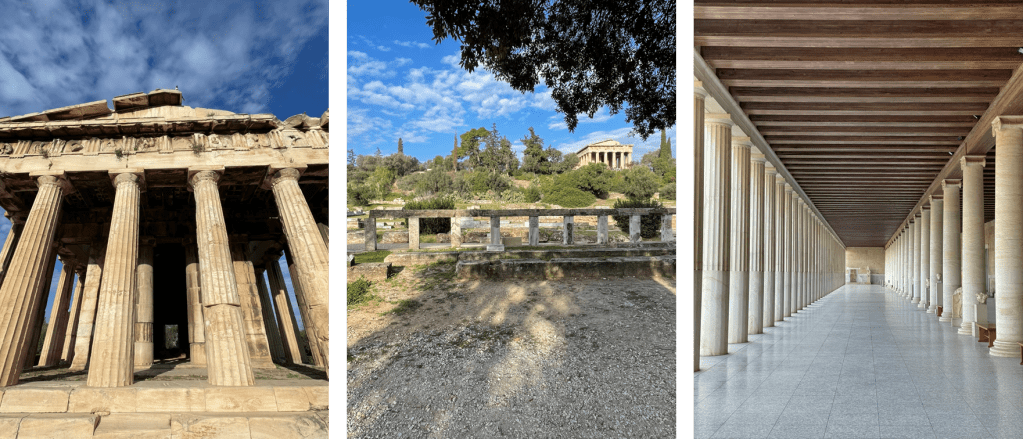
From left to right: the temple of Hephaestus, the Shrine of the Eponymous Heroes, and the Stoa of Attalos.
The next morning, I went to the Agora as soon as it opened. Walking down the gravel paths for the first time is like stepping into the pages of history. The Temple of Hephaestus, stoic and imposing, stands as a testament to ancient craftsmanship of the time.
The Shrine of the Eponymous Heroes, a central feature in Athens’ Agora, was a monument where statues of ten tribal heroes stood, serving as a civic hub for posting public notices and facilitating the administrative functions of Athenian democracy. It wasn’t what I thought it would be at all, though maybe I would have thought differently if the statues where still there.
Nearby, the restored Stoa of Attalos is now the Agora Museum, a small building that contains some of the artifacts I had recently studied in my Greek History class. They had a kleroterion which was a device where citizens’ names inscribed on bronze plates were randomly selected for civic duties, using colored balls in a lottery-like mechanism to ensure fairness and impartiality. Next to that display was one holding ostraka, or pottery shards that citizens would use as a ballot by scratching names onto to cast a vote.
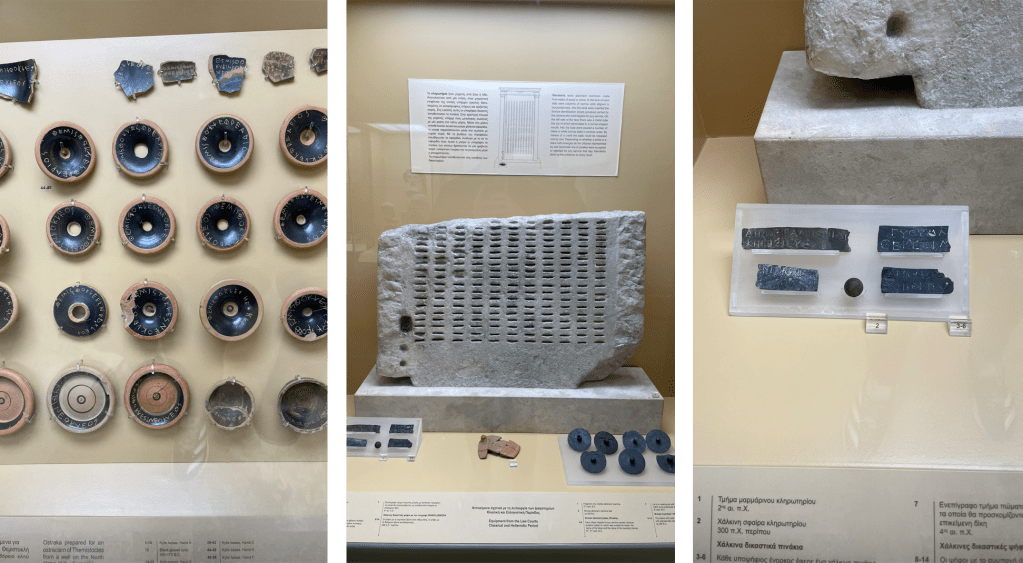
From left to right: bases from broken pottery used for ostraka, a kleroterion, and a closer look of the bronze plates.
There was plenty to see in between each of those monuments inside the Agora, and I could have spent a whole day here. But I had to get to the Acropolis!
Exploring the Acropolis
Standing atop the rugged Areopagus Hill, one must immediately appreciate the architectural mastery of ancient Athens. The Parthenon, with its grand Doric columns, dominates the skyline, a testament to the city’s golden age. Just a stone’s throw away, the Erechtheion boasts the elegant Karyatids, figures of serene beauty that have stood as silent guardians for centuries. It’s remarkable to consider the daily hustle of ancient Athenians here, navigating the steep, rocky, and slippery paths in simple sandals and togas.
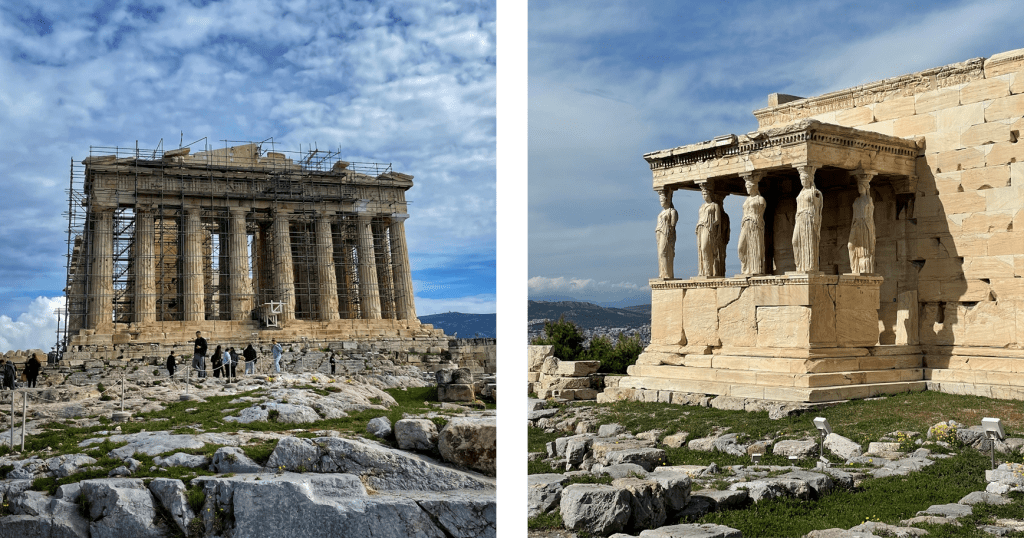
The Acropolis getting a little bit of a facelift on the left. On the right is the Erechtheion with replicas of the Karyatids.
It was a happy accident that I did the Acropolis Museum before the Acropolis itself. I felt like I already knew everything as I walked around the site and didn’t feel the need to read all the displays as the sun beat down on my face. I was able to wander around and take everything in as if I had already been there many times before!
There’s so much more I could talk about, but I’ll have to save it for future posts. Expect the food, that you’ll be able to read about in Part 2!
 Lost Luggage and the Art of Traveling Light
Leave a comment