Now that I’m home and have mostly survived jet lag, I thought I’d write about my experience traveling internationally during this blasted pandemic. This is to share my experience and to hopefully help others have an idea of what to expect, but this is definitely not the single source of truth for anything or anyone but myself. The only thing that is consistent in this experience is the inconsistency and everyone’s mileage will vary!
The way I prepared for this trip was to first prepare for where I was going, then to prepare to get home, then to prepare for the time in between, including emergencies, sudden policy changes, etc. It was a wild, and expensive, ride.
- Contents
- Germany and Luxembourg entry requirements
- Pre-departure Covid test through Curative
- Pre-departure Covid test through XpresCheck
- Protective gear
- The flights
- The airports
- Luxembourg mandates
- Self-administered Covid rapid test
- Germany mandates
- Returning to the US, Covid test through EcoCare at the Luxembourg airport
- Final Covid test once home
- My tips if this is something you want to do
Air travel
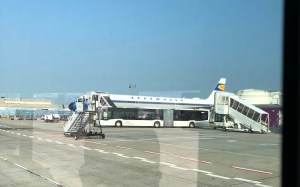
Old school Lufthansa branding at the Frankfurt airport
Luxembourg was my final destination, but as there are no direct flights from the US, that meant I had to change planes in another country, which means I had to meet their entry requirements (which could have changed at any time). I chose a flight with a layover in Frankfurt, so that meant I needed to follow Germany’s entry requirements as well as Luxembourg’s.
There is so much conflicting information out there, I decided to monitor the requirements using the European Union’s official Reopen EU app. Regions are color coded to make it easier (presumably) to tell if there’s a policy change lurking in the background. Things in Germany were green the whole time, so I would at least be able to get to the EU. Luxembourg had turned red, but it was pretty easy to see what that meant (mandatory masks, limited capacity, quarantine rules, etc.).
Germany and Luxembourg entry requirements
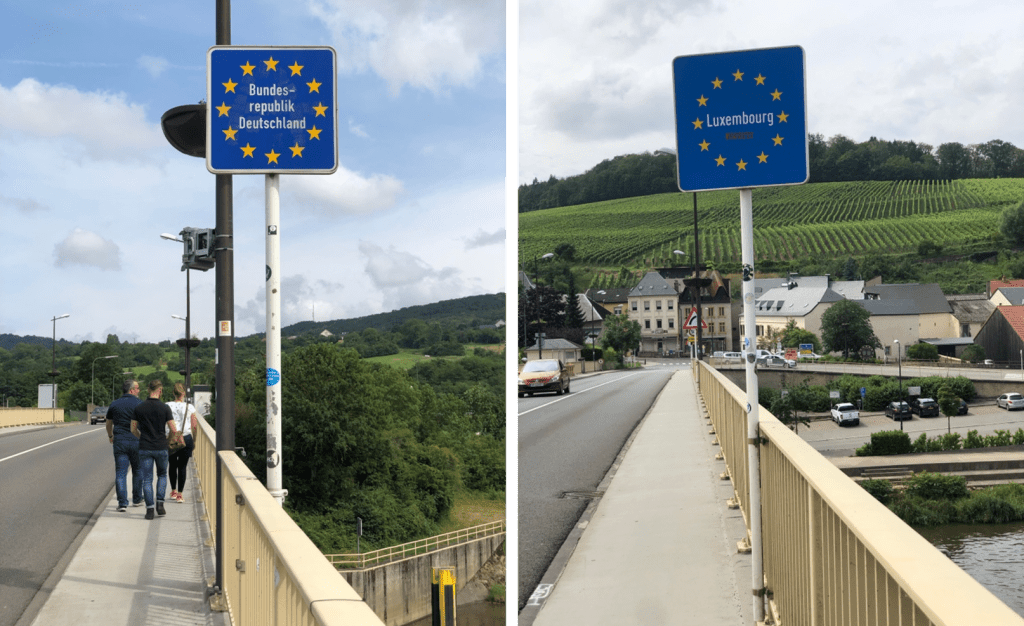
I walked to Germany and back to Luxembourg
To enter Germany all I needed was my vaccination card, but to enter Luxembourg, I needed a negative Covid test taken no more than 72 hours before boarding time because my vaccination wasn’t “issued by a public or medical authority of a Member State of the European Union or of a Member State of the Schengen Area.”
Pre-departure Covid test through Curative

Photo source: http://www.willemsplanet.com/2021/01/16/saturday-winter-tennis/
So, I made an appointment to get my Covid test the day before I left because at the time I made my appointment, turnaround time was about one day. The City of Seattle has free Covid testing through Curative, and since I have new health insurance through work I haven’t navigated yet, I figured the easiest thing to do was get the free test since it was supposed to come back in time, and the site was a stone’s throw away from my apartment.
When I checked into my appointment, the website then said it was taking at least 48-72 hours for results to come back due to a bit of a surge that the delta variant has been causing. I thought about hopping on the plane and hoping for the best, but I wasn’t sure when I needed the proof of vaccination. At the ticket counter? Gate? Passport control? By this point I had conflated needing the negative test result with getting into Germany, which added a bit to my confusion when the guy at the ticket counter next to me didn’t know he needed a test and asked instead to show his vaccination card, which the ticket agent accepted, but I’m jumping the timeline a bit here.
Pre-departure Covid test through XpresCheck
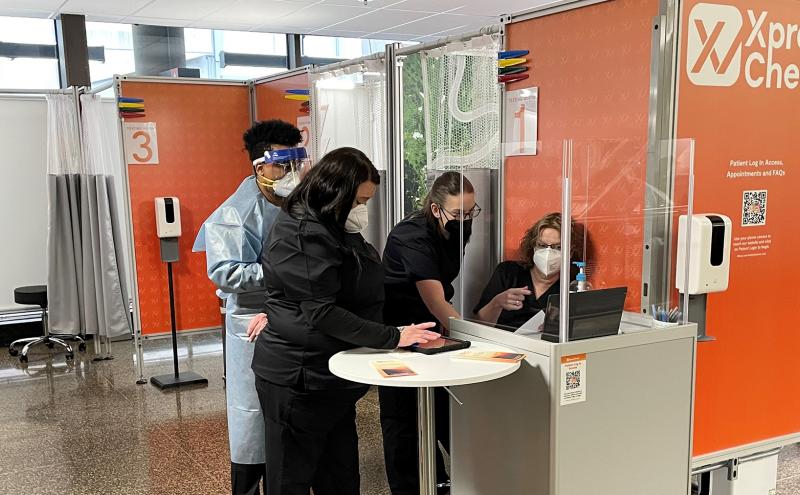
Photo source: https://www.portseattle.org/news/xpreschecktm-opens-covid-19-testing-facility-seattle-tacoma-international-airport
I didn’t have my test result by the morning I was supposed to leave, so for the first time in my life, I willingly got myself to the airport hours and hours early (like, 4 whole hours, and I like to live life like I’m on Amazing Race) to get a rapid PCR test through XpresCheck. I made an appointment online and waiting until the very second it was time for it just in case my free test results were delivered so I wouldn’t have to pay the $250 USD that XpresCheck charges <insert 500 crying emojis here>. The odds were NOT in my favor, I checked in, got my nose swabbed, and handed over my credit card. I had my results in an hour.
The person who swabbed me was telling me that there were many people who had to get these last-seconds tests because they, like me, didn’t receive their results in time, and some people never received their results at all!
I showed the negative test result to the ticket agent, tried not to have a meltdown when dude next me didn’t even think about getting a test, collected my boarding pass, and proceeded to the gate.
Protective gear
For those who don’t know, I’m a bit of a germaphobe. I blame my high school biology teacher who showed us just how disgusting our hands were by having us put our fingers on some gel stuff in a petri dish and then a few days later showing us ALL THE THINGS that grew from it. I believe we need some germs in our lives to strengthen our immunity, but there is a limit to that, and I get a bit squidgy thinking about the zillions of people who have sneezed into their hands and then touched a handrail, for example. I try to limit how much I touch in high-traffic areas because I just don’t want to get sick. This has made me exceptionally fun in the last year and a half, let me tell you.
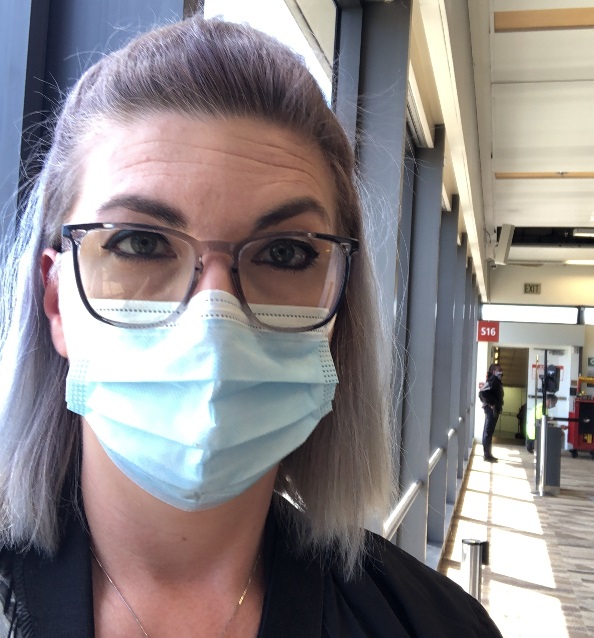
Obviously, masks were required on the plane. I opted for a medical mask since it would be better protection than any of the cloth masks I usually wear when I’m out and about, and it turned out that these were required by the airline (Lufthansa) anyway.
Since there is a possibility of ocular transmission of Covid, I also got a pair of Stoggles to wear in the airports and the flights. They are anti-fog, so I can wear them with a mask, and they would keep me from accidentally touching my eyes with my grimy disgusting hands.
The flights
There wasn’t too much of difference as far as the flights were concerned. Both the outbound and return flights were full, no spacing passengers out at all. They gave us a large moist towelette to wipe our area down. There was no second drink cart after the meal, but return flight still had the very important ice-cream bar cart. I didn’t get up at all during my flight to minimize the amount of contact with others (not sure if it really matters) so I don’t know how compliant other passengers were with mask wearing. I didn’t hear any fuss though. Upon arriving in Frankfurt, and boarding heading back to the US, they crammed the entire plane into a bus shuttle everyone from the plane to the gate, though they made us deplane by row to limit everyone’s movement. So, yeah.
The airports
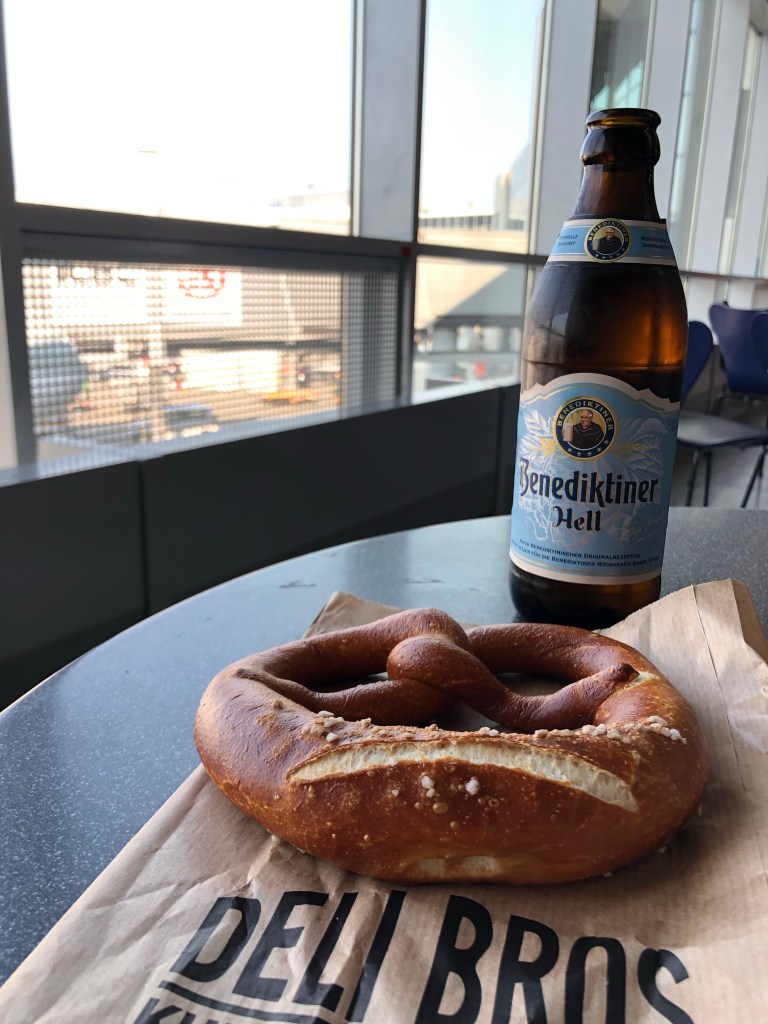
Obligatory Welcome to Germany Pretzel and Beer
At the airports, most people wore their masks appropriately. I only saw one person without one, and some people wouldn’t cover their noses. In Frankfurt, they try to enforce social distancing by taping off seats, but it really seemed like this just corralled people to other areas where they were still close together. People still crowded the gate at boarding, but the two food lines I stood in people seemed to keep social-distance space. People ate and drank anywhere they could.
Luxembourg mandates
In Luxembourg it was required to wear masks in enclosed areas. Bus drivers would yell at people who tried to lower them below their nose. Most places required you to use hand sanitizer when you entered the building. Restaurants were more or less closed to inside seating unless you had the approved proof of vaccination, took a rapid Covid test, or there was sudden thunderstorm and they were nice enough to overlook the rules and let you sit inside. Though one place had me eat inside not meeting any of those three conditions, so it wasn’t exactly consistent.
Self-administered Covid rapid test
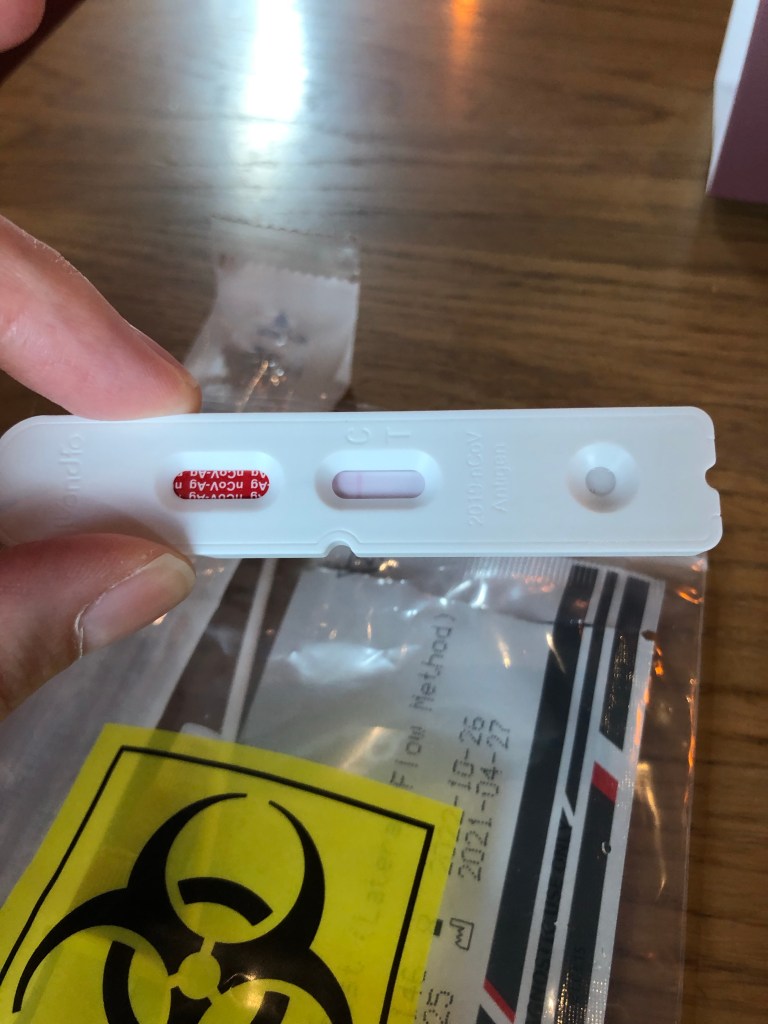
Pre-dinner science. An amuse-nez, if you will.
One restaurant did not have outside seating available and so they gave me a rapid test to take before I could take my mask off. I got a brief pantomimed demonstration as the kit did not contain any instructions at all. So of course I didn’t do it correctly and then another server came over to help me. Just in case you find yourself in this situation, here is how to do this kind of test at your restaurant table yourself:
- The nose-swab part should be fairly obvious. Don’t let the cotton touch anything but the inside of your nose. You don’t need to swab your brain with these, just the inside of your nostril. It will probably tickle. Swab one side for 10 seconds, then the other.
- Open the tube with the fluid it in and put the swab in it, cotton side down. Don’t let the swab touch anything but the inside of the tube and the fluid.
- This part I don’t remember exactly, but I had to stir the fluid with the swab to get them to intermingle. I think it was something like 10 times or for a minute.
- Put the cap on and take the little cap off the end. You now have a dropper. Place 5 drops of fluid in the hole of the part that looks like a pregnancy test. Most of the fluid should be used.
- Wait 10 minutes, but it starts to look pretty clear after 5.
- Whatever my test read meant I tested negative for Covid.
Germany mandates
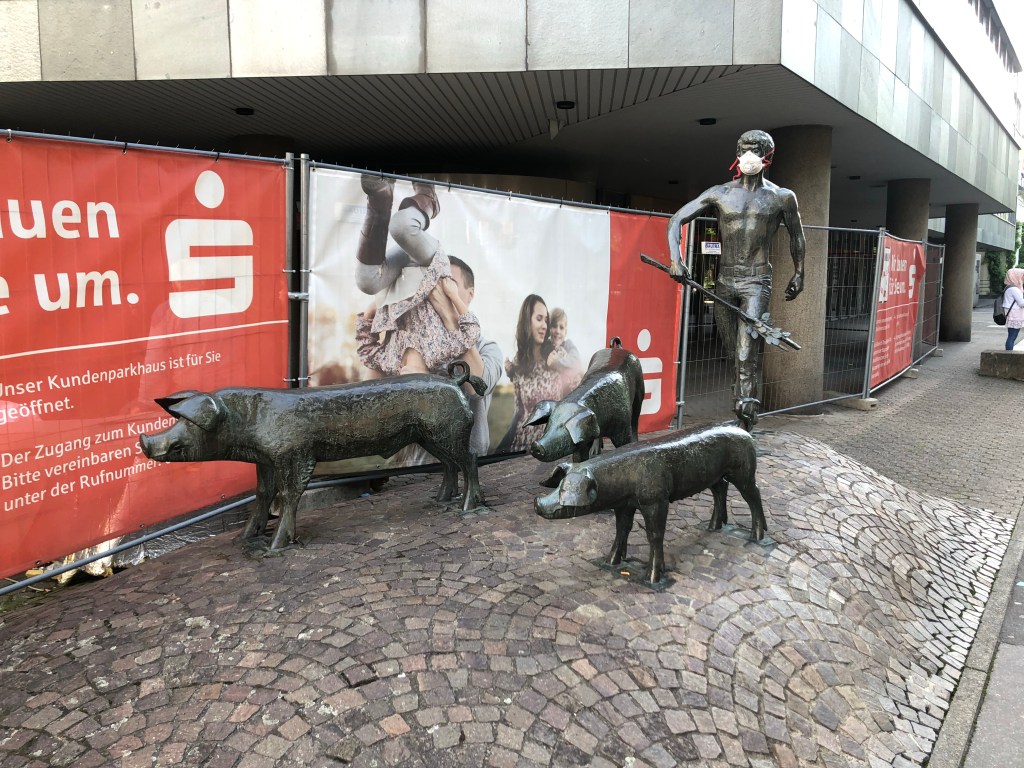
Even the statues had to wear masks in Trier.
That was Luxembourg. Germany was a bit different.
Traveling between the two countries was no different than the before times. When I checked into my hotel I was asked for a negative test or my vaccine card. Restaurants allowed anyone inside, you just had to fill out your contact information so they could do contact tracing if someone reported a positive case. Same at museums. In Luxembourg one can wear cloth masks anywhere, but in Germany the requirement was to wear medical masks or N95; no cloth masks or the like were allowed. This was in Rhineland-Palatinate at least, I’m not sure if this was a country-wide thing or not.
Returning to the US, Covid test through EcoCare at the Luxembourg airport
To return to the US, I had to have proof of another negative Covid test (or proof of recovery which doesn’t apply in my situation). I made an appointment at the Luxembourg airport and got it done 2 days before I left since they guaranteed the test to come back in 36 hours. This cost €119 or about $140 USD. This swab was a throat swab, not through the nose. I can understand some French, and when the person told me “ouvrez la bouche,” my brain basically short circuited. I couldn’t figure out why I needed to open my mouth to have my nose swabbed… I asked, “Ma bouche? My mouth?” and they explained that it was a throat swab, which I was NOT mentally prepared for! I steeled myself for the swabbing which I felt much less than anything that had gone up my nose.
Getting this result was another stressful element of the journey. I received a text message saying my result was ready, but the process in which to retrieve it was not clear at all. It was not available through the site where I made the appointment, and instead asked me for the Luxembourg resident number, or my username to log into this system. I couldn’t for the life of me figure out what the username was; I tried everything that was available to me. The day of my departure I went back to the testing center at the airport and asked for help, which also wasn’t clear. After a few more moments struggling to log in (they said it was the code I got at my appointment, I was looking for a QR code or a barcode), I asked for help again, and finally they made it clear that my username was a sticker I had received at the time of my appointment with an alphanumeric code that I had completely forgotten about. Luckily, I still had it, so I logged in and got my result and was clear to fly home.
I had to show my negative result when I landed at SeaTac, too.
Final Covid test once home
Finally, when I got home, I scheduled another free Covid test just to make sure I didn’t get anything on the plane, and I got that back last night. I survived international travel during the pandemic unscathed, but not with a serve amount of additional stress and expense. I only went on this trip to take care of my Luxembourg citizenship quest as soon as the border was open to US passports and before anything else could possibly jeopardize my mission. A part of my heart and soul was happy to be traveling again, but it was not a relaxing trip by any means for me. My nervous system is in a heightened state during this time and traveling was no different. How people can treat their vacation as they did in the before times and not give two thoughts about it is half admirable and half unbelievable to me. While I’m VERY happy that I went and overall did have a great time, I will not be making more plans to travel internationally soon.
My tips if this is something you want to do
I know there are some people who will think that by this point in the pandemic, things should be figured out. Timelines should reliable, information should be clear, but the fact is things can change quickly and it’s not worth investing in a process that might be moot in a moment.
Here are some tips for anyone who does wish to travel internationally at this time:
- Find an official source for the country/countries you want to visit. The Reopen EU app was what I used. Check embassy and consulate websites. Do not rely solely on the airline’s website as it is not official and there could be a delay with updates.
- Monitor that source constantly the week before you leave. Check the news in the area. Are cases rising? Are new mandates going in effect?
- Keep checking the news in your country, too. If there’s a huge breakout, the country you reside it could be suddenly considered a “high risk” country, which may have mandatory quarantine rules upon landing. Do not think that just because you live in one part of the US where there isn’t a large outbreak, and there is a large outbreak on the other side of the country, that the entire country wouldn’t be considered a “high risk” – I’m pretty sure it will be.
- Carry extra medical masks with you, as well as hand sanitizer. Change your mask after each flight you take if you can get to an area where you far away from other people and can quickly change your mask.
- Be flexible and understanding.
- Have a budget for rapid tests, unplanned quarantines, and any other emergencies.
- Have a plan for what to do in the case you do get sick and end up in the hospital.
- I understand some reasons people are reluctant to get the vaccine, but I encourage everyone to get one!
Again, this is just my experience in July 2021 to Luxembourg and Germany and I hope someone may find it helpful in some way.
 Lost Luggage and the Art of Traveling Light
Leave a comment